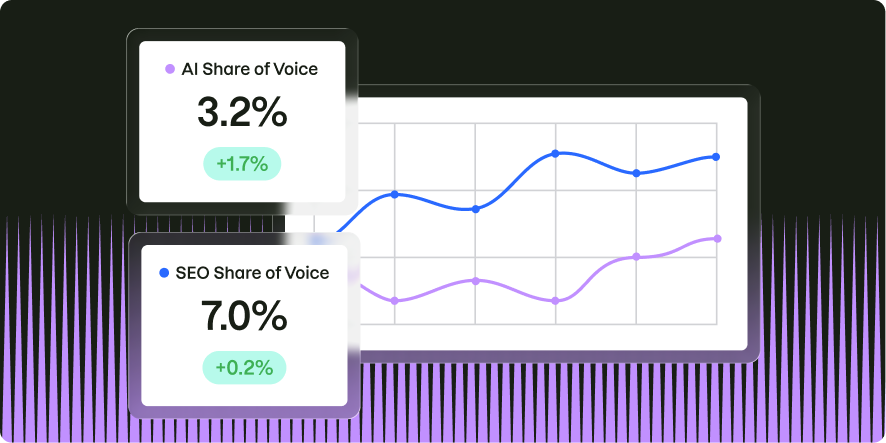
AI searches are rising while regular Google searches are holding steady at 93-96% of total activity. Search is expanding. As is the amount of content being produced.
These factors make your content more vital than ever. It also needs to be optimized holistically across search engines and AI. However, refining for both channels can feel like a combination of existing SEO best practices and guesswork.
Semrush Enterprise AIO’s Content Optimization capabilities change that. Your content creation can now follow a guided process for comprehensive visibility in real-time.
What’s Important for High-Performing Content?
For SEO, keyword coverage (naturally), relevance, domain authority, and readability are all examples of crucial considerations. The signals are well established but this higher baseline just adds to the level of competition.
In AI search, high-performing content is about topical coverage, building your authority, ensuring consistent messaging. AI platforms pull from web content that’s well-structured, clear, and relevant to specific questions. They don’t read your article top to bottom, but follow signals to extract what’s useful.
AIO combines both approaches, analyzing relevance, structure, and topical completeness, providing precise guidance to help ensure your content piece performs across both Google and AI search:
- Get precise recommendations to improve visibility in AI and SEO results
- Understand what makes top-performing content successful
- Fill content gaps and boost topical authority with SERP and LLM analysis
Scoring That Swaps Guesswork for Guidance
1. SEO
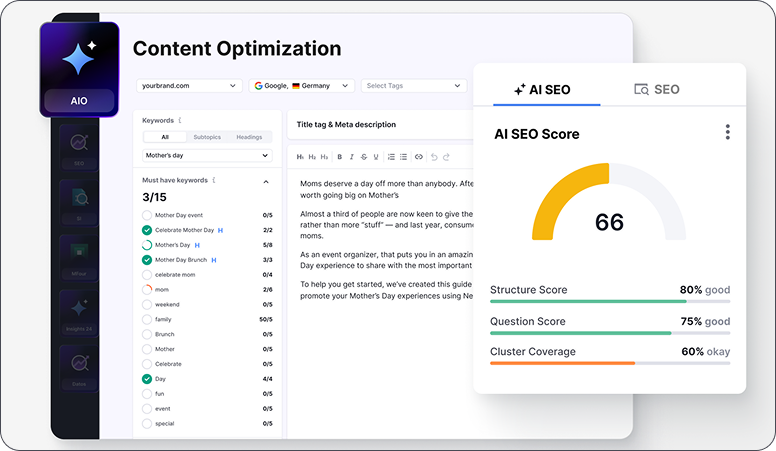
While you’re likely familiar with SEO best practices, AIO’s live scoring gives you feedback on a number of content foundations as you write:
Keyword Coverage: Are you including the right terms?
As the name suggests, this indicates how well your content covers all the terms specific to the search query.
AIO’s scoring helps you avoid keyword stuffing with a recommended frequency that’s based on SERP leaders and the current length of your content piece.
SERP Relevancy: How do you stack up with the current leaders?
The breadth and depth of your work is compared against current SERP leaders in a more comprehensive analysis.
This score helps ensure your content covers necessary and complementary context, without getting tangential or introducing irrelevant information.
Spam: Are there any unnatural or repetitive phrases?
The spam score ensures that there's no accidental keyword stuffing going on and that content is providing enough information to be valuable to readers.
Readability: Is your content easy or difficult to read?
Here your content is run through the Flesch-Kincaid test for a score out of 100. More complex topics will naturally have a higher score, but publishing accessible content should always be your aim.
2. AI Search
Question Score: Are you answering what users ask?
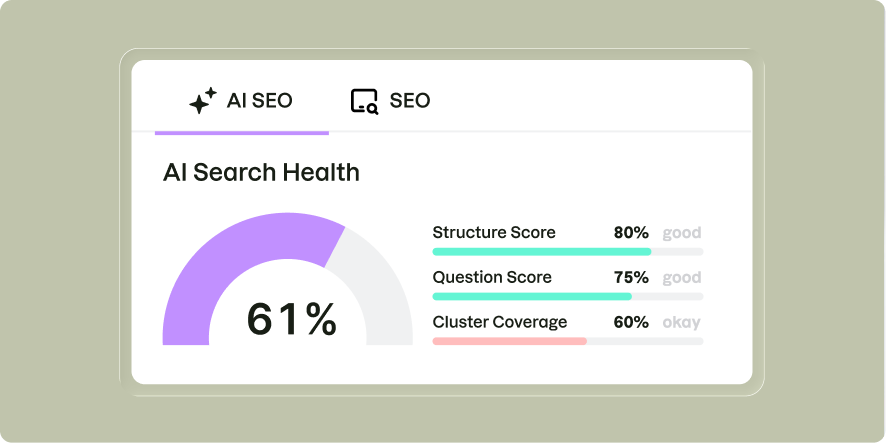
This measures the percentage of essential questions your content covers for a given topic. For example, those that cover the key “who”, “what”, “where”, “when”, “why” information.
Covering multiple key questions upfront helps improve your topical completeness and increases your chance of citation in a wider number of AI responses.
Cluster Coverage: Are you giving the full context?
AI models understand topics as networks of related ideas rather than keywords.
After the central questions, cluster coverage then uses actual data from LLM outputs to evaluate whether your article includes relevant subtopics (for example, if you’re writing about “sustainability,” have you discussed carbon impact, renewables, and green policies?).
Broadening the scope of your article helps establish authority and broadens the range of search prompts you can appear for.
Structure Score: Is your content clear to AI (and humans)?
Perfectly correct information won’t perform if it’s difficult to read. The structure score measures readability, formatting, and clarity.
From a consistent heading hierarchy to balanced paragraph lengths and scannable formatting, these elements ensure people, and AI models, interpret meaning accurately.
STEP BY STEP DEMO
How to Structure Content for AI Search
As the newer search channel, the blueprint for winning content is still being written for AI search. Structuring your content is key.
AIO automates the heavy lifting through a more detailed analysis, there are a few foundational rules for structuring content. Here’s an introductory list of best practices and why they matter:
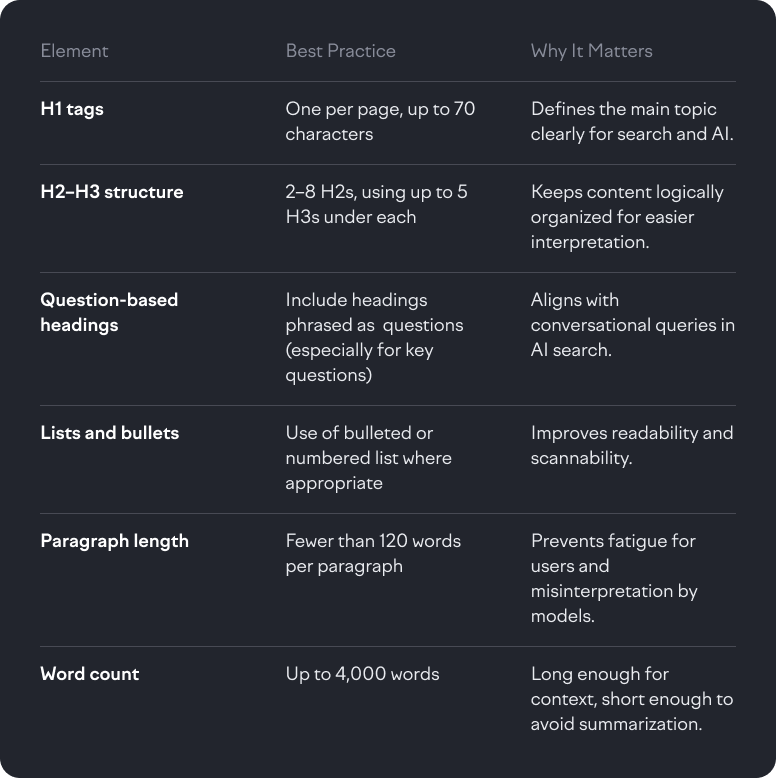
Each content piece receives a total AI Visibility Score that combines all three dimensions for easy benchmarking. Plus it updates live as you edit, so you can see how your changes impact performance in real-time.
Write Optimized Content from Scratch with AI
Looking to snatch an opportunity and quickly draft some content? Semrush Enterprise AIO allows you to generate optimized content in an instant.
The built-in AI writing features automatically follow best-practices, generating a full, structured draft that you can tweak to best match your tone of voice. You can also use AI support to enhance or ideate on existing copy, all from within the editor. It even helps craft titles and meta descriptions that meet SEO and AI standards.
Plus with the real-time scoring alongside, you can refine with total confidence and publish knowing that every piece is optimized from top to bottom.
Create High-Performing Content with AIO
Creating high-performing content requires clarity, structure, and topical relevance that search engines, AI, and people instantly find value in.
With AIO, you get the blueprint to do just that.
- Understand what your content is missing
- Optimize with precision and structure
- Generate AI-ready copy that performs from the first draft
With AIO, the next time you hit publish, you won’t be guessing. Your content will be built to perform.