Site health, SEO, and AI search all inform one another. Any missing context or misaligned insights can have serious repercussions for how customers are able to find your brand. Therefore building sustainable brand visibility requires that your teams and data are more connected than ever.
Yet many enterprise teams are reporting a sprawling set of search tools. We recently surveyed 481 enterprise marketers and found that most are using at least 2-3 different tools. Some are juggling at least 5 at once.
Here’s what enterprise marketers must consider from the announcement and moves to take next.

Each added tool compounds the brand visibility risk. Semrush for Enterprise’s new Report Studio, however, helps to mitigate this. Helping you to unite the metrics that matter most, organize them for the right audiences, and continue to grow your discoverability. Attribution can prove challenging without dedicated AI search solutions, but that’s not where the customer journey ends.
Brands still track downstream branded queries, direct visits, and assisted conversions over delayed windows, as these can indicate users who first discovered or evaluated the brand through AI search and returned later to continue their research.
Why brand visibility demands connected data layers
Website health is the prerequisite for discovery. SEO and AI crawlers both have to access, parse, and trust a site's content before anything else can happen. If a site is unretrievable, slow, or poorly structured, or hard to crawl, your content won’t be showing up in either channel. If this data sits in a vacuum with your website development team, then your SEO and marketing functions lack foundational context.
On top of that sits SEO. An overwhelming majority of search demand rests here, and this layer informs everything above it. The content depth, structure, and authority signals that determine organic rankings are largely the same signals AI systems draw on to decide what to cite. Strong SEO fundamentals don't just win rankings; they shape AI search performance.
Then comes AI search, the layer that's shaking up channel ownership for a specific reason: visibility there isn't triggered by one channel. It's constructed from owned content, media coverage, affiliate placements, and citations a brand doesn't directly control. A far broader set of inputs than a ranking algorithm. That's exactly why most organizations are struggling with ownership: no single team sits across all of those triggers, so no single team can see the whole picture.
Site health, SEO, and AI search are interconnected. The more search expands and becomes a gatekeeper for your brand, the more vital it becomes for data to reflect a single, unified system rather than three disconnected ones.
Separate ownership isn’t the problem, lack of integration is
AI search has meant that ownership of brand visibility is often scattered between SEO teams, brand/PR, growth, dedicated AEO functions, and shared committees. Or in some cases, no clear owner at all. While a complete lack of an owner is problematic, the biggest harm may come in the form of siloes.
The cost here shows up directly in performance. 81% of marketers whose SEO and AI search execution are fully integrated report increased traffic or leads from AI platforms, versus just 36% among teams running siloed workflows. That 45-point gap has far less to do with tactics than with whether anyone can see the whole picture at once.
Seeing the whole picture is rare. Adobe’s Search Everywhere Optimization Playbook found that 74% of marketers have no measurable strategy for AI search and LLM discovery at all, or are unaware of one within their organization.
Altogether, this presents a widening gap between brands that can see their full visibility picture and brands that can't.
How to diagnose a reporting gap with SCALE
Here's a model for auditing whether your reporting stack is actually built for Brand Visibility, or just stitched together after the fact. If yours can't cover all five points, it's likely to struggle across a large organization.
S — Single view: SEO, AI search, and website health data in one view, not three tools and a spreadsheet stitched together manually.
C — Connected: Data should pull live from the source. When a static export needs a caveat every time it's presented, buy-in and trust start to wane.
A — Audience-specific: Segments and date ranges persist across every reload, across every product area.
L — Lasting: A thoughtful template built once can become the organizational standard that can be iterated on, not a one-off deck produced from the insights at hand.
E — Efficient: Key for any large organization or agency. If finding or reading the dashboard takes longer than acting on it, it isn't infrastructure but well-intentioned clutter.
These benchmarks help you to overcome slow approvals, unclear ownership, and fragmentation, the organizational factors most likely to be your search strategies biggest threat.
STEP BY STEP DEMO
How Report Studio solves these
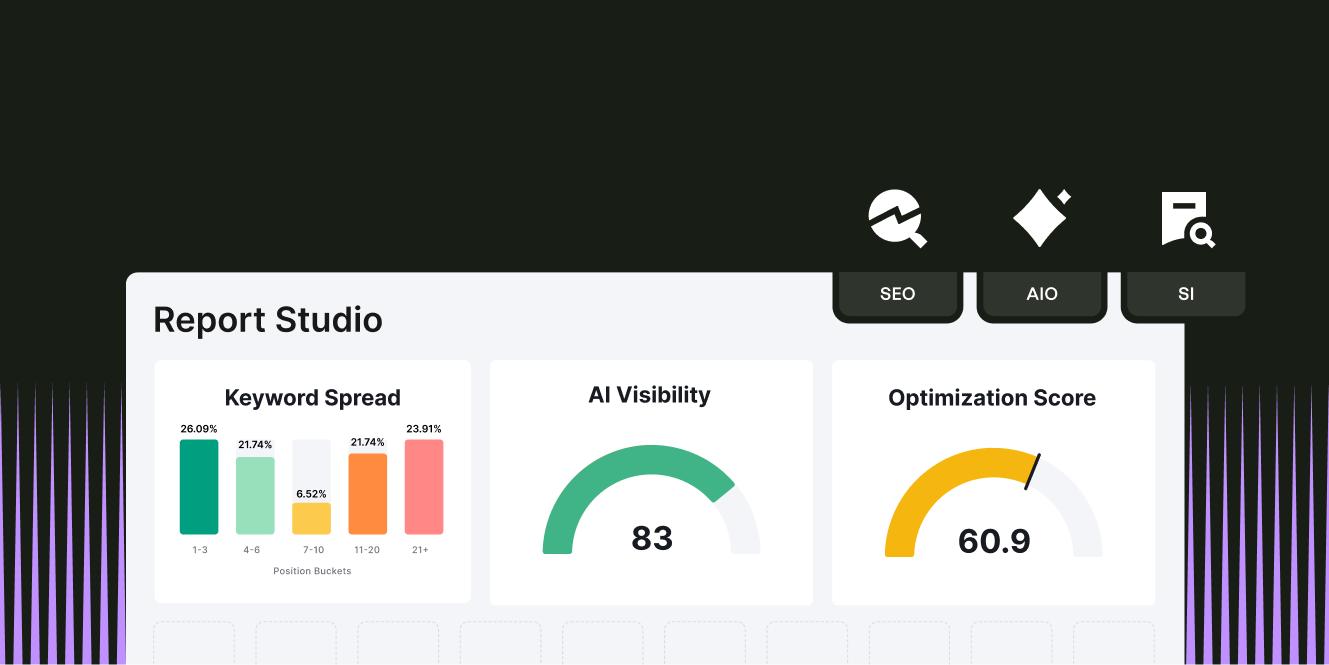
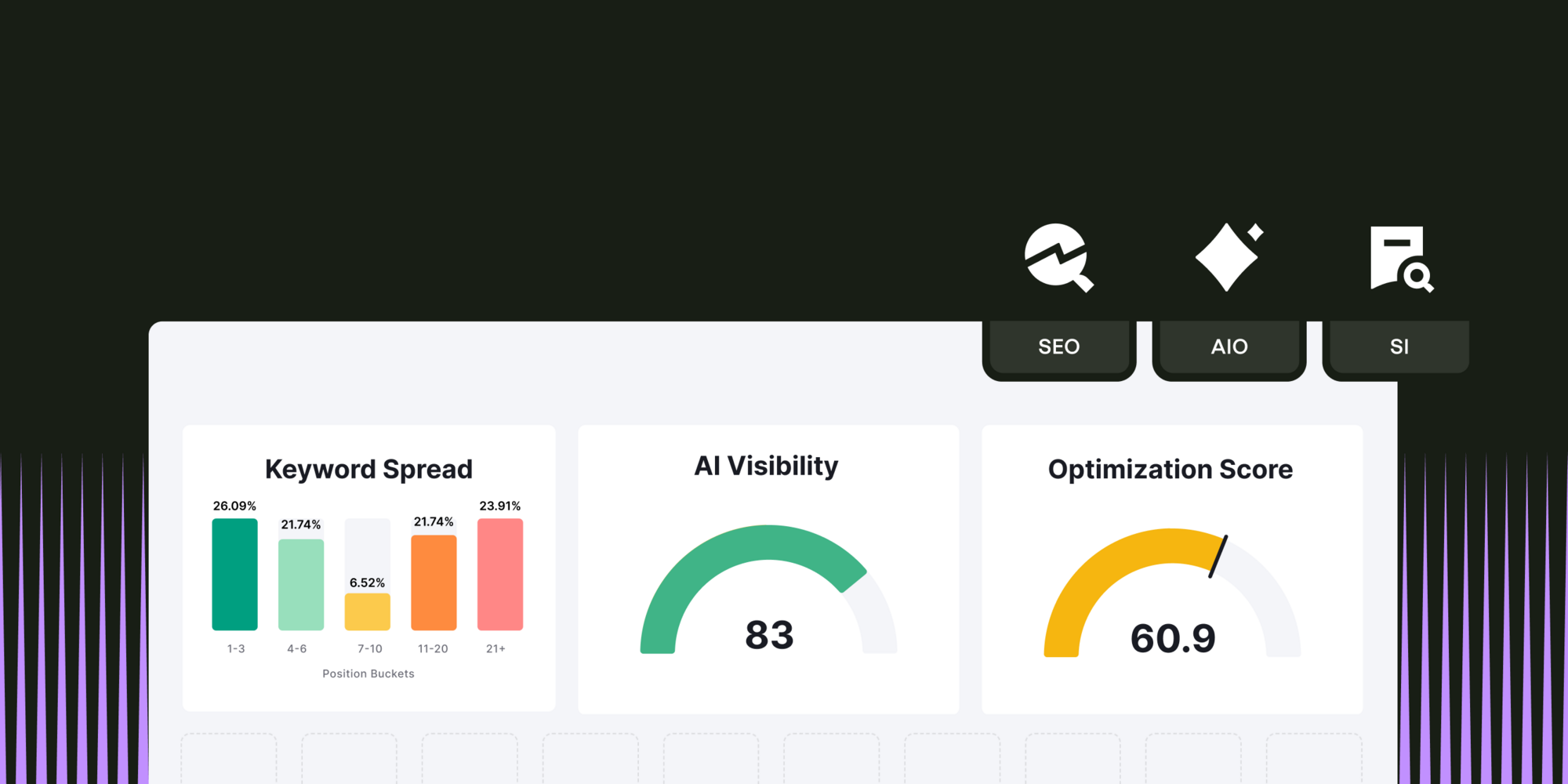
Report Studio is Semrush for Enterprise's native answer to the SCALE gap. built inside the platform where SEO, AIO, and Site Intelligence data already connect, rather than bolted on as a separate export tool:
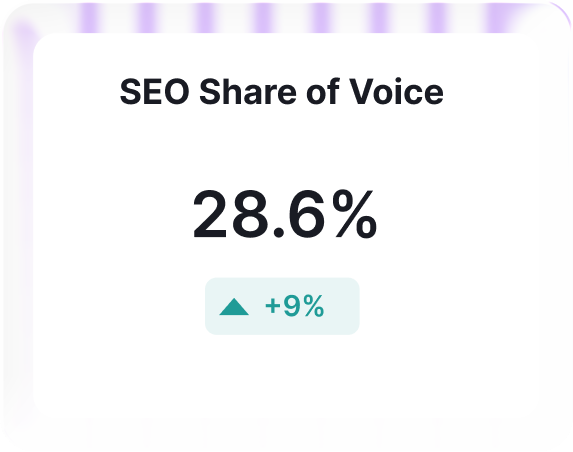
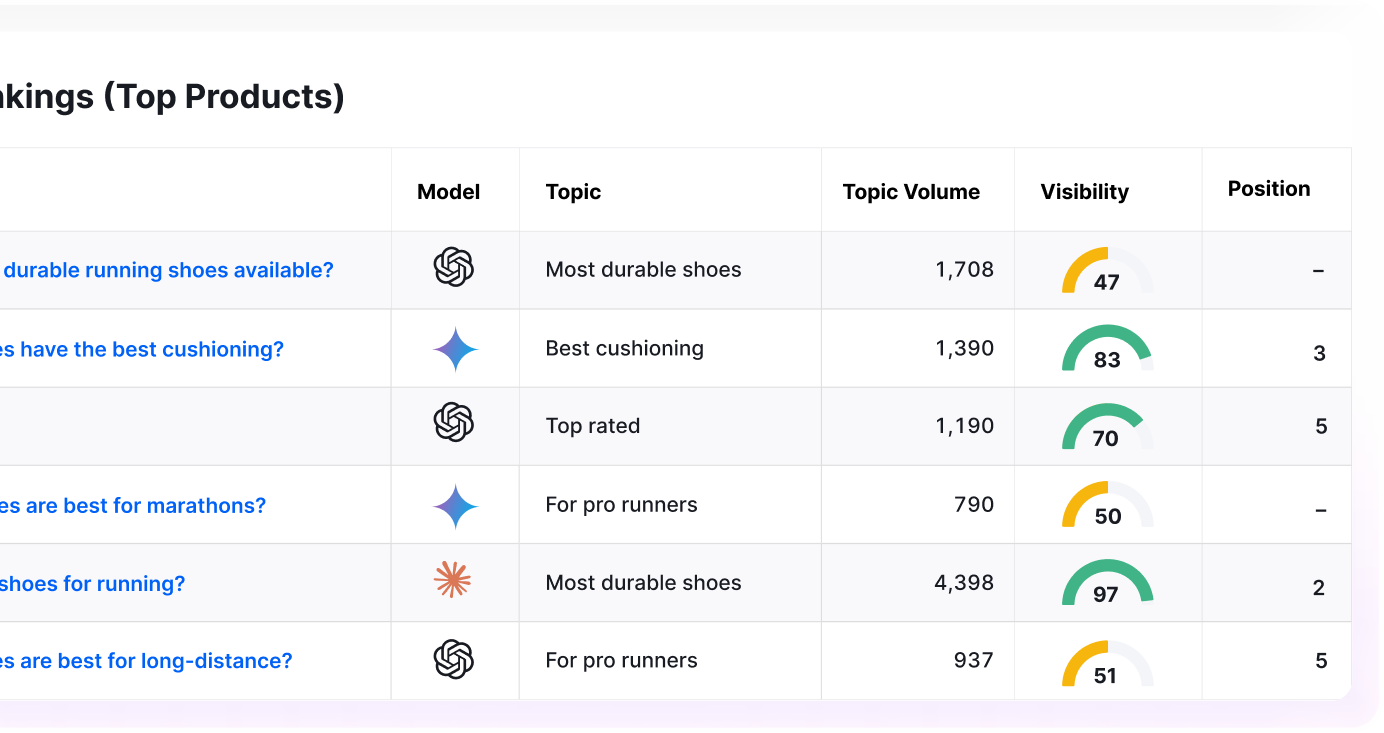
Cross-product reporting: combine data from across Enterprise SEO, AIO, and Site Intelligence into one view, to put an end to manual data reconciliation
Live-connected widgets: saved elements track the original reports, so upstream shifts automatically carry through instead of quietly going stale
Customizable: persistent filters and visualizations mean that you can tailor reporting for stakeholder groups once and they remain active through every reload
Structured organization: nest key reports by region, product category, or client to ensure your source of truth is effortlessly findable
Reporting is the mechanism by which your Brand Visibility strategy gets funded, defended, and scaled. Alternatively, it gets deprioritized or lost between the cracks, jeopardizing a brand’s future discoverability
Your next steps
Start by mapping any potential ownership gap. Ask different stakeholders who owns Brand Visibility across your organization. If the answers don't match, there's a cause for concern.
Next, score your reporting structure against the SCALE model. If more points fail than succeed then the cross-functional effort that Brand Visibility requires could be falling victim to fragmentation.
The organizations that establish a connected system around Brand Visibility will hold the advantage as the rest of the market works to catch up. Report Studio is built for that inflection point, inside Semrush for Enterprise, rather than sold as one more tab to check.