What did we study?
SEO and AI search. How connected are they? While many GEO platforms take the view that they’re different processes, Google has continually asserted that they’re fundamentally the same.
Our stance has always been that SEO is foundational to AI search. So we set out to investigate the connection.
After analyzing the top 10,000 domains appearing in our AI Visibility Index, we found a clear connection between SEO performance and visibility in AI search platforms.
The strongest relationship came from organic keyword footprint. Across the AI platforms analyzed, the correlation between the number of keywords a domain ranked for and the number of AI citations it received sat tightly between 0.86 and 0.87.
Authority showed a similar, though less consistent, pattern. Domains with an Authority Score of 81 or higher received around nine times the median citation share of domains scoring 60 or below. The focused correlation between Authority Score and AI citations was 0.70 on Google and 0.43 on ChatGPT.
Importantly, this analysis shows correlation rather than causation. But how AI search retrieves information provides an explanation for why this relationship exists.
Organic keyword footprint has the strongest link to AI citations
Of the different SEO signals analyzed, the keyword footprint stands out as an incredibly strong indicator.
A correlation of 0.86 to 0.87 means domains occupying more of the organic search results also tend to be cited much more frequently by AI platforms. This tight range also means that the trend is consistent across AI platforms.
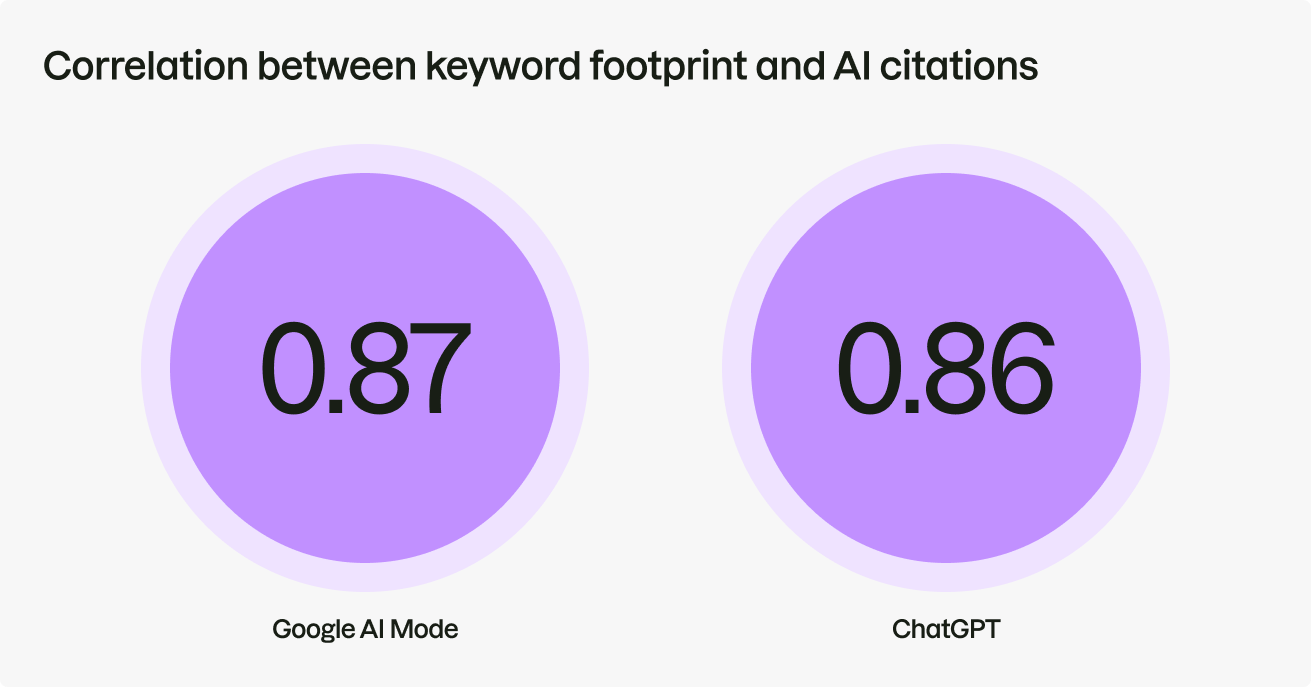
Keyword count is useful here because it captures more than performance against a small group of priority terms. A domain ranking across many relevant queries is likely to cover considerably more of its subject area: products, concepts, questions, comparisons, use cases, problems, and supporting information.
That breadth naturally creates greater topical coverage and therefore wider scope for AI retrieval.
This matters because AI search platforms use query fan-out to extend research beyond the exact prompt that someone types. This results in generating multiple related queries to gather the information required to answer a single prompt.
Query fan-out raises the value of topical depth
Research from Anthony Lee gave a sense of how query fan-out changes the actual number of searches. This found that 1,323 fan-out queries were generated from 540 parent queries across ChatGPT, Gemini, and Perplexity.
That gives us a natural mechanism for this correlation.
Imagine a prompt that asks for recommendation of a CRM for a global retailer. Research underneath that prompt could involve enterprise CRM software, retailer requirements, international CRM platforms, integrations, security, scalability, pricing, and comparisons.
A domain with strong organic visibility and keyword coverage across the topic has multiple chances to enter the retrieval process. A domain with narrow coverage has fewer.
One core commercial topic may lead into dozens of supporting information needs. Product capabilities connect to implementation. Implementation connects to integrations. Integrations connect to security, governance, pricing, comparisons, customer proof, and technical documentation.
Strong SEO programs have been building those connections for years and AI retrieval gives that work another route to supporting brand visibility.
For enterprise search leaders, keyword footprint therefore tells us something bigger than how many SERPs a website occupies. It shows how much relevant information the domain makes available when AI goes looking for answers.
Domain authority adds mixed advantages
Our same analysis found that domains with an Authority Score above 81 received approximately nine times the median citation share of domains scoring 60 or below.
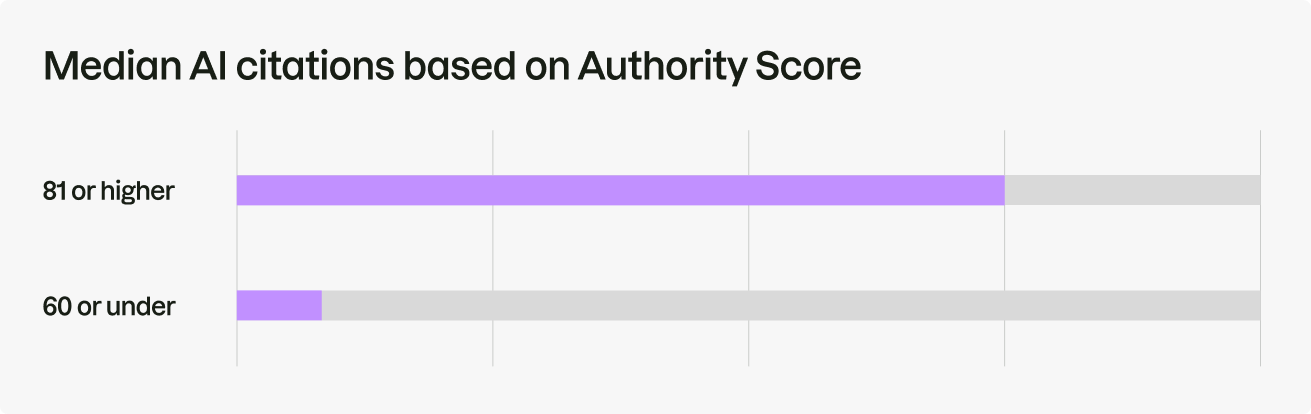
Authority Score combines signals like link power and estimated organic traffic, and checks designed to identify unnatural backlink profiles.
So the ninefold difference points towards a wider set of characteristics common to established websites: strong backlink profiles, sustained organic performance, trusted external references, and a substantial presence across search.
However, domain authority was less predictive of citations than keyword footprint. This correlation also varied widely by AI platform.
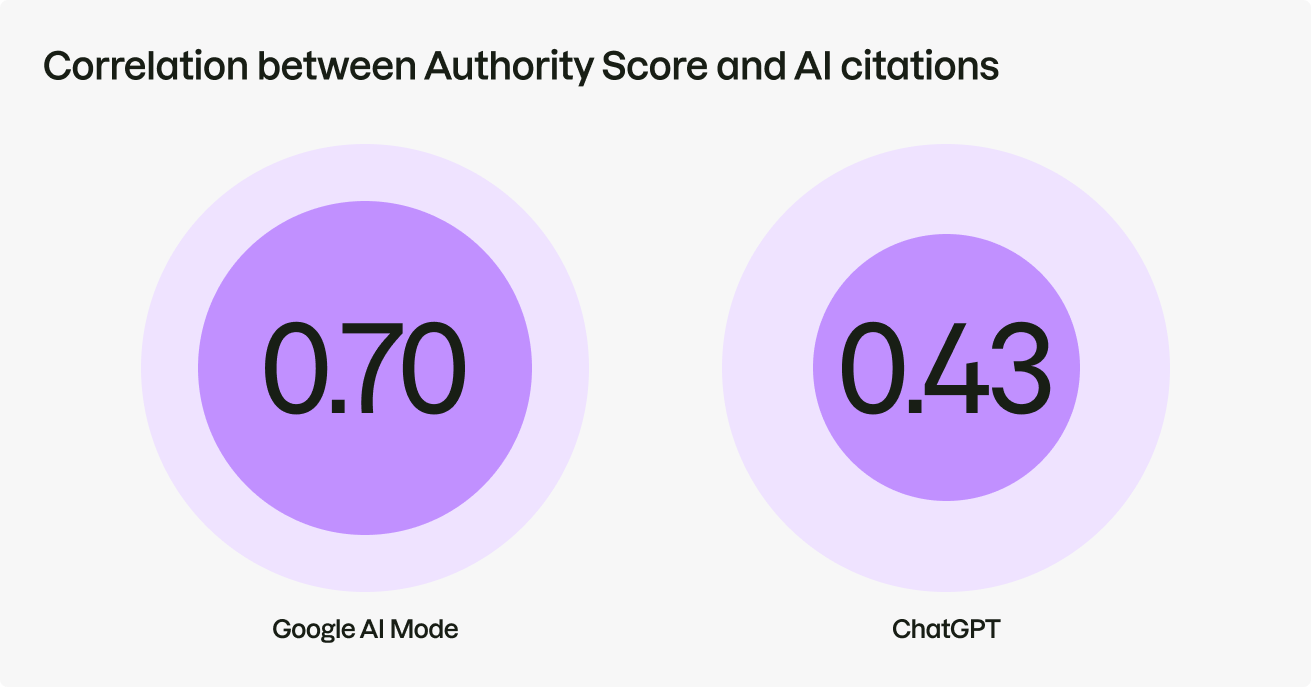
This suggests that having a strong, established domain provides advantages—especially in Google’s AI ecosystem. While keyword coverage maps to AI citation performance more closely. A powerful backlink profile doesn’t substitute for having useful, topically-deep pages.
It also reinforces the need to measure AI platforms independently, as each model retrieves and selects information differently.
What marketing teams can take away
For enterprise marketing teams, these findings point to multiple priorities:
- Protect organic search performance while expanding AI search initiatives. SEO performance remains crucial in its own right, while offering close association with citations. Track and optimize both in tandem to ensure sustainable brand visibility.
- Create content with both SEO and AI search in mind. Short term GEO tactics can provide short term AI visibility lifts to the detriment of organic search performance. Sustainable brand visibility is built on content that’s aimed at maximizing performance across both over time.
- Measure your topical footprint, not only priority rankings. Your head terms tell part of the story. Analyze fan-out queries to to understand the breadth of relevant subqueries, use cases, comparisons, and questions your domain covers.
- Keep building authority alongside coverage. Backlinks, external references, organic traffic, and a healthy domain profile remain associated with stronger AI performance, even though the relationship varies by platform.
- Measure AI platforms separately. Differences in correlation between Google and ChatGPT shows why a single blended “AI visibility” number hides important differences.
How Semrush for Enterprise enables holistic brand visibility
Semrush for Enterprise brings SEO, AI search, and technical site health together in a single platform, providing teams with connected data, workflows, and reporting.
This amplifies earned SEO foundations through to stronger AI visibility, as well as business outcomes. 81% of enterprise marketers with connected SEO and AI search operations report more traffic and leads.
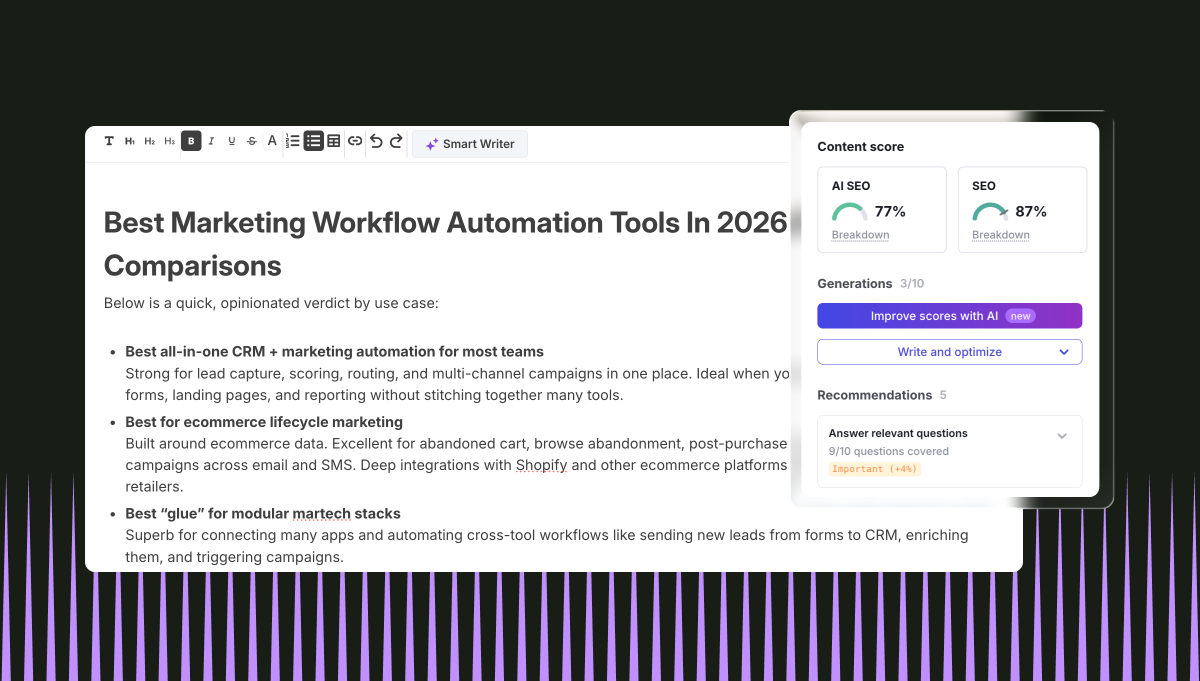
Central to achieving holistic brand visibility is balanced content, and Semrush for Enterprise enables this through live scoring and suggestions for SEO and AI search performance.
Acting faster on content opportunities doesn't come at the expense of quality. AI drafts use your brand voice to target keywords and fan-out queries to build topical depth, while accounting for your organization's unique delivery.
Sustainable brand visibility is built on connected SEO and AI search
For marketing teams, this helps to quantify the case for connecting SEO and AI search workflows. The 0.86 to 0.87 correlation between citations and keyword footprint links AI search with the clearest match between SEO and organic search presence.
The ninefold citation advantage for domains with Authority Scores above 81 suggests another layer. This sits alongside the 0.70 correlation for Google AI Mode.
All together, they support the notion that domains with strong SEO foundations are heavily represented in AI search platforms. Because strong topical coverage puts more relevant pages in reach. Authority then strengthens the wider signals around those pages.
This adds further weight to enterprise’s need for connected capabilities that can scale across their teams, markets, and product lines.